
By exception, another PDF-Monday.
OpenCL vs. OpenMP: A Programmability Debate. The one moment OpenCL and the other mom ent OpenMP produces faster code. From the conclusion: “OpenMP is more productive, while OpenCL is portable for a larger class of devices. Performance-wise, we have found a large variety of ratios between the two solutions, depending on the application, dataset sizes, compilers, and architectures.”
Improving Performance of OpenCL on CPUs. Focusing on how to optimise OpenCL. From the abstract: “First, we present a static analysis and an accompanying optimization to exclude code regions from control-flow to data-flow conversion, which is the commonly used technique to leverage vector instruction sets. Second, we present a novel technique to implement barrier synchronization.”
Variants of Mersenne Twister Suitable for Graphic Processors. Source-code at http://www.math.sci.hiroshima-u.ac.jp/~m-mat/MT/MTGP/
Accelerating the FFTD method using SSE and GPUs. “The Finite-Difference Time-Domain (FDTD) method is a computational technique for modelling the behaviour of electromagnetic waves in 3D space”. This is a project-plan, but describes the theories pretty well. Continue reading “PDFs of Monday 16 April”


 Say you have a device which is extremely good in numerical trigoniometrics (including integrals, transformations, etc to support mainly Fourier transforms) by using massive parallelism. You also have an optimised library which takes care of the transfer to the device and the handling of trigoniometric math.


 With the launch of twitter-channel
 There is a lot going on at the path to GPGPU 2.0 – the libraries on top of OpenCL and/or CUDA. Among many solutions we see for example Microsoft with C++ AMP on top of DirectCompute, NVidia (and more) with OpenACC, and now
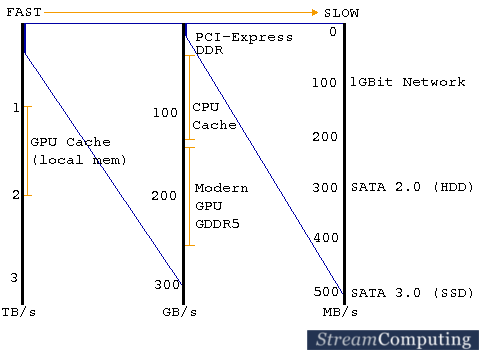
 We zoom into the slower bus-speeds. So all the good stuff is at the left and all buses to avoid are on the right. What should be clear is that a read from or write to a SSD will make the software very slow if you use write-trough instead of write-back.

 Does your computer have OpenCL-capable hardware? Read on and find out if your computer is compatible…


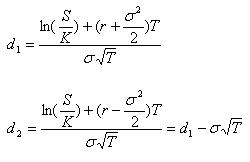
 Intel, AMD and NVidia have all written implementations of the Black-Scholes algorithm for their devices. Intel has described a kernels in their

 HTML5 has the future, now Flash and Silverlight are abandoning the market to make the way free for HTML5-video. There is one big problem and that is that it is hard to protect the content – before you know the movie is on the free market. DRM is only a temporary solution and many times ends in user-frustration who just want to see the movie wherever they want.



 Typos are a programmers worst nightmare, as they are bad for concentration. The code in your head is not the same as the code on the screen and therefore doesn’t have much to do with the actual problem solving. Code highlighting in the IDE helps, but better is to use the actual OpenCL compiler without running your whole software: an Online OpenCL Compiler. In short is just an OpenCL-program with a variable kernel as input, and thus uses the compilers of Intel, AMD, NVidia or whatever you have installed to try to compile the source. I have found two solutions, which both have to be built from source – so a C-compiler is needed.



 In the series
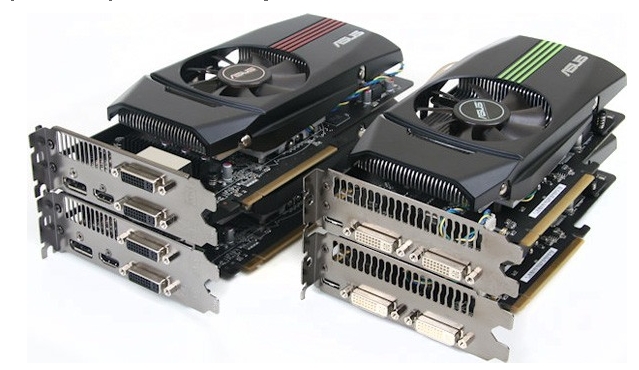


 The

 Years ago Microsoft was in court as it claimed Internet Explorer could not be removed from Windows without breaking the system, while competitors claimed it could. Why was this so important? Because (as it seems) the browser would get more important than the OS and internet as important as electricity in the office and at home. I was therefore very happy to see the introduction of WebGL, the browser-plugin for OpenGL, as this would push web-interfaces as the default for user-interfaces.
