

Several projects were introduced to us via the company’s GPU-pioneer. These collaborations were very successful and pleasant to do, due to the internal support within the company. This is a reason we would like to do more of these – this text is dedicated to the GPU-pioneers out there.
Seeing the potential of GPUs is not easy, even when you’ve carefully read the 13 types of algorithms that OpenCL can speed up. So it’s even harder to convince your boss that GPUs are the way to go.
Here is where we come in. This is what you need to do. Continue reading “Looking for the company’s GPU-pioneers”

 The main strength of Artificial Intelligence is it’s easy to understand by anybody. This results in new applications in all industries at a rapid pace. Are there new possibilities generated or have the possibilities always been possible? The answer is both.


 Would you like to run CUDA-kernels on the OpenCL framework? Or Python or Rust? SPIRV is the answer! Where source-to-source translations had several limitations, SPIRV 1.1 even supports higher level languages like C++.
 How interesting is SPIRV really?

 In the release notes for 378.66 graphics drivers for Windows (February 2017), NVIDIA officially spoke about supporting OpenCL 2.0 for the first time. Unfortunately, this is partial support only and, as NVIDIA said, these new [OpenCL 2.0] features are available for evaluation purposes only.
 In


 We have several wishes for 2017 and two of them are to make code for the open source community. Luckily HiPEAC is interested in more collaboration between academia and industry and therefore
 The fifth International Workshop on OpenCL (IWOCL) will be held on 16-18 May 2017 in Toronto, Canada. The event kicks-off with a full-day Advanced Hands-On OpenCL tutorial which is followed by two-days of conference: keynotes, academic papers, technical presentations, tutorials, poster sessions and table-top demonstrations.
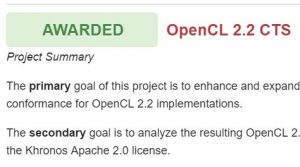 Some weeks ago we started with implementing the Compiler Test Suite for OpenCL 2.2. The biggest improvement of OpenCL 2.2 is C++ kernels, which originally was planned for 2.1. SPIRV 1.1 is another big improvement.

 To temporarily increase capacity we put Quartus 16.0.2 on an Ubuntu server, which did not go smooth – but at least smoother than upgrading packages to required versions on RedHat/CentOS. While the download says “Linux” and you’re expecting support for multiple Linux breeds, there is only official support for Redhat 6.5 (and CentOS).
 One of the world’s most used software is far from performance optimised and there is hardly anything we can do about it. I’m talking about Excel.